Showing posts with label West Bank. Show all posts

Saturday, May 15, 2010

The West Bank pt.3- Bethlehem & The Shepherd's Fields


On the road north to Bethlehem from Hebron we passed the Al Arov refugee camp and the Jewish settlement of Efrata, one of the largest in the West Bank. These sights highlighted two of the major issues remaining between Israelis and Palestinians. The refugee camps are poorer than even the towns in the West Bank, having high unemployment and little hope. Many of the people (or their family) either abandoned their homes in Israel proper when Israel declared itself a sovereign nation in 1948 or when Israel took control of the West Bak after the Six Day War in 1967. Many of these camps are recruiting grounds for fundamentalists, who can used the depressed conditions in these camps as a rally point for their cause. Sam told me that many people on the West Bank, including those in refugee camps went into Israel proper everyday to work. The most amazing thing he relayed to me is that in order to work exit the West Bank for work, candidates must be over 30 and married. This is something I had never heard and was amazed at this policy. It's really oppressive, but it does eliminate the demographic that suicide bombers and terrorist usually come from- young, angry, immature, men who see no future for themselves.

The settlement of Efrata is large, and I could see the place where construction was ready to begin. The problem with the Palestinians receiving the West Bank and Gaza as a place for their own country is that there are hundreds of Jewish settlements dotting the area. Most of the settlements have their own bypass roads and heavy security. The settlers inside these towns religious fundamentalists, believing that they must settle the West Bank so that it remains part of Israel. This is not a political argument for them- they believe that this land was given to the Jews by God. The Israeli government for many years encouraged these settlements, then after receiving international criticism, turned a blind eye to them. In recent years, the government has been much more restrictive in allowing new settlements to be founded, but the existing one have continued to grow. After seeing these in person, I still wonder how a Palestinian state is ever supposed to work. I can see a scenario where the Israeli government forces these settlers from their homes- that would lead to widespread rioting by the most powerful & vocal minority the country has. It's also hard seeing the Palestinians happy with a land that is divided geographically by all of the lands and roads these settlements have- there would be no geographic cohesion to it.

We made our way into Bethlehem. I'd seen heavy tourist traffic in Jerusalem, but Bethlehem was bursting at the seams. The song says 'O Little Town of Bethlehem' and it couldn't be more wrong. I'm sure it's meant to refer to the time of Jesus, but today Bethlehem is a large, fast moving, heavily-touristed place. The above picture is some of the famous street art done by UK artist Banksy. There were a couple of different paintings, the most famous of which are in the Dheisheh Refugee Camp, adjacent to Bethlehem.


Our stop in Bethlehem was at Manger Square and the Church of the Nativity. The church claims to be the oldest continuously used Christian church in the world. The spot is, for the most part, recognized as the actual spot where Jesus was born, since the Roman Emporer Hadrian has a shrine built to a pagan god here to distract attention away from this spot by Christian pilgrims. It was Constantine's mother, the same woman responsible for the building of The Church of the Holy Sepulchre, who had the first Christian church built here in 339 AD.


Tourists flocking the Grotto of the Nativity

The star marks the spot of Jesus' birth

The area where Jesus was laid after being born

The main attraction here, of course, is The Grotto of the Nativity. There was a huge line of tourists lines up to make their way down the stairs and visit the cave where Jesus was born. There was also a section of the cave where Jesus was first laid, which was set up as it's own separate shrine. I'm usually pretty synical about these places, but it was amazing to see the masses who has flocked here because of devotion. Many in the crowd were so touched by the experience that they left the grotto in tears.

The church itself was massive. It contained evidence of many different periods, Roman, Byzantine, Crusader, and most recently Greek Orthodox. Particularly interesting were the Byzantine era mosaics.

Next door to The Church of the Nativity was The Franciscan Church of St. Catherine's. This church was beautiful and airy inside, quite a conrast from the dark and brooding Church of the Nativity next door. My guide, Sam, was married in this church.
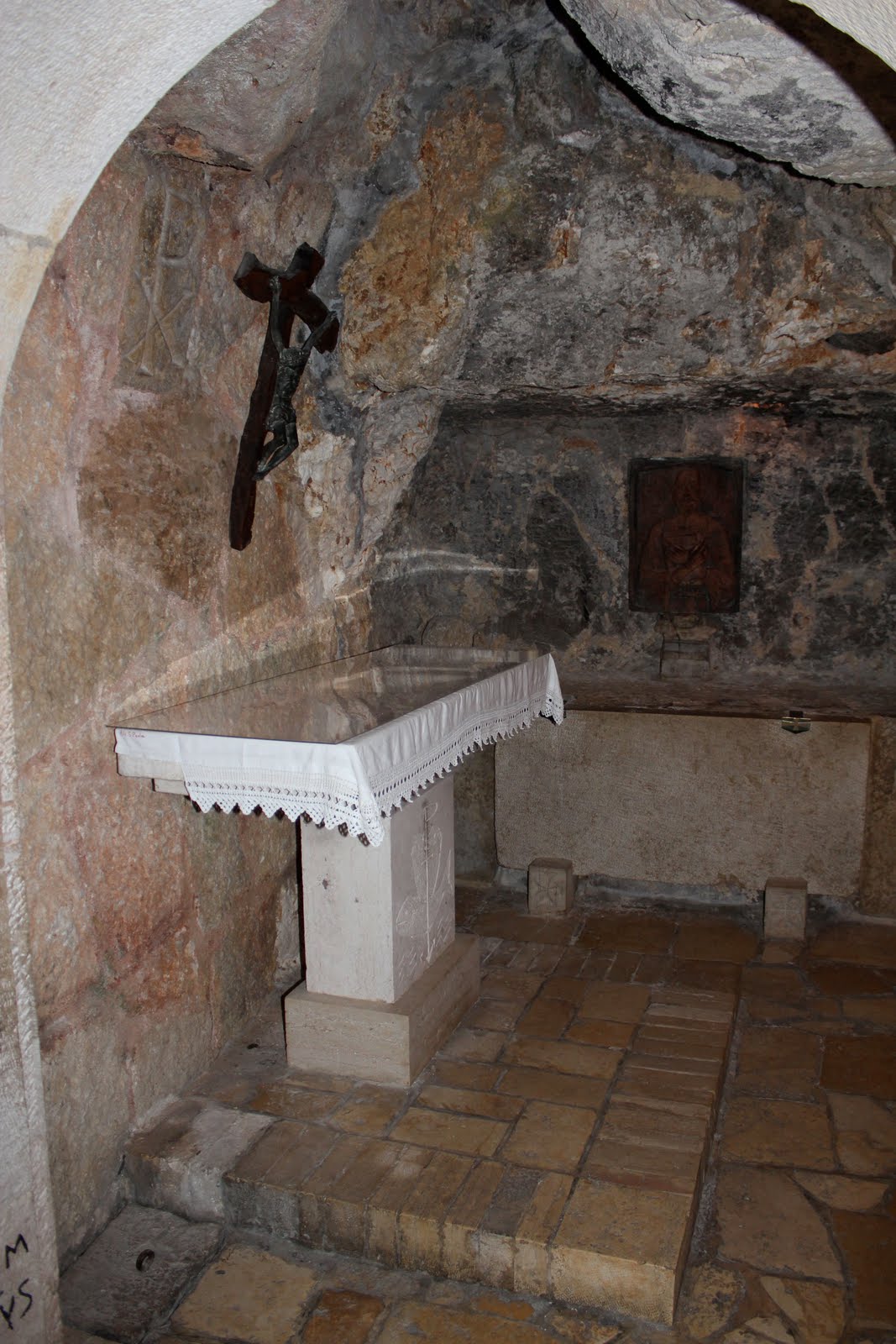

Below St. Catherine's was the Cave of St. Jerome, where he first translated the Bible from Greek and Hebrew into Latin. The cave also contained the tomb of St Jerome and some beautiful stained glass.

Upon exiting St. Catherine's we were able to look up and see bullet holes on the side of The Church of the Nativity from the 2002 siege that took place there. The Israeli Defense Force raided Bethlehem looking for 200 Palestinian militants, who fled to the church and for 39 days, in a widely covered incident, held monks and some innocent civilians captive. The siege ended somewhat peacefully, with the militants releasing the captives in exchange for being deported to Jordan or Gaza instead of being released. I was told that many of the militants, especially the ones taken to Gaza, have since been killed in raids and air strikes, and many of the other were later arrested by the IDF for other crimes.


On our way to our last stop at the Shepherd's Fields, Sam and I stopped for a lunch of turkey shawarma and Palestinian beer.


The Shepherd's Fields were a little underwhelming. The area around the fields have been so built up, and the site itself was so touristy, that it was impossible to imagine the scene of 'The multitude of angles" appearing to the lonely shepherd's to announce Jesus' birth. The site did contain a church with some beautiful paintings of the story.

The single most striking feature of the shepherd's fields was the electrified fence that has been built right through it. It was a fitting way to end the day. It perfectly summarized my feelings about the West Bank, a land seperate and divided. Controlled by one side, but holy to many. My hopes are for some sort of lasting peace in the future that both parties can live with, although nothing I saw on that day would give me the impression that's possible.

One last note, I mentioned in the first part of this article that I had carried my passport in my front pocket all day, expecting to have to show it a number of times. The actual number it was checked- zero. Maybe that's some progress....

Sam & I at Shepherd's Fields

Friday, May 14, 2010

The West Bank pt.2- Mar Saba & Hebron


My expectations of what would happen on the way out of Israel proper and into the West Bank had grown inside my head as the trip approached. Sam asked me when I got into his car if I had my passport. I usually carry it in my money belt, but for today I was going to carry it in my front pocket. All I had read left me expecting to have to show it at least 10 times. I expected the checkpoints to be a small break in the 'Seperation Fence', the 471km fence the Israeli Government is building on the border with the West Bank. The above picture is the fence as seen from the lookout behind the Seven Arches Hotel on the Mount of Olives. Where Sam & I crossed, it was a small check point, with the fence nowhere to be seen and a seemingly regular chain link fence (with some nasty looking barbed wire on top). Sam told me that this fence was also electrified, and that made it seem more formidable.


The West Bank itself is poorer than the rest of Israel. Lifestyles tend to be more traditional, as seen in the pictures above. Much of the West Banks economy relies on tourism, that's why times of unrest are particularly damaging for residents in these parts. Much of the rest of the economy is agricultural, especially in the northern part of the West Bank, and herding of sheep, camels and cows, is dominant in the drier south. Industry is the West Bank is almost non-existent, since the Israeli government has made it hard for Palestinian entrepreneurs to get permits to build factories. Few people would have the money to, as well, although Sam told me that some factories are starting to open up.

Mar Saba Monastery
The caves where Sabas originally settled

The Kidron Valley

Our first stop of the day was the monastery at Mar Saba, some 25km east of Jerusalem, in the baking Judean desert. The devout Saint Sabas occupied the caves opposite the current site of the monastery in the late 5th century BC. His popularity lead to a following of over 70 faithful monks, joining Sabas in his desert sanctuary. The first churches were build here in the early 6th Century. Destroyed by constant invaders, especially the Persians & Ottomans, and also by earthquakes, the current buildings are from the 1800s. They are dramatically perched over the Kidron Valley. The photos I have fail to give the proper perspective. It was the photo of this place in a book I saw before coming that drew me to want to visit it. Not getting the proper viewing angle was not the only disappointment for me, since upon arrival, we were met by a chattering monk, explaining that the main priest had gotten up early for prayers and was napping then eating, meaning we could not visit the inside of the compound itself. He did allow us to step inside the front gate so that Sam could explain what the buildings were from the balcony. He also didn't allow me to take any pictures from the inside. Sam said he'd had problems with this particular monk before.

We continued Southwest toward Hebron, passing Heroduim, King Herod's palace/fortress built during the time of Christ into a low hill.
Tomb of the Patriarchs/ Ibrihami Mosque

I'd wanted to visit Hebron for a few reasons. The first was that all my sources said that Hebron was a good place to get a peak into everyday Palestinian life in the southern West Bank. Nablus & Jenin in the northern part were the best place to find this, but those were out of my reach on this trip. The second reason for visiting Hebron, was to visit The Tomb of the Patriarchs, or the Ibrahimi Mosque. The building's history is as controversial as the history of the city itself. The shrine built over the Cave of Machpelah, the traditional resting place of Abraham, his wife and their offspring, was open to both Jews and Muslims, since both religions see Abraham as their patriarch. In 1994, Baruch Goldstien, a resident of the neighboring Jewish settlement of Kiryat Arba, walked into the Mosque dressed in his IDF uniform and with his IDF issued rifle, opened fire on Muslim worshippers, killing 29 before he was beaten to death.
Evidence of repairs of a bullet hole from the Goldstien massacre

Since the massacre, the building as been divided into Muslim and Jewish sections. Both sides have access to the tombs of Abraham and his wife Sara, with the tombs of Issac and Rebecca residing on the Muslim side, and the tombs of Jacob and Leah on the Jewish side.

The Tomb of Abraham

Security checkpoints existed at both entrances, but Sam and I were able to get into both sides.
The Muslim side was beautiful, with elaborate rugs, a gift from the King of Morocco adorning the floor in every direction. This side also contained a beautifully carved minbar (pulpit) from the time of Ottoman ruler Salah ad-Din in the late 12th Century.
The minbar and mirhab (central point of worship facing Mecca) were located between the tombs of Isaac and his wife Rebecca.

The Tomb of Jacob
The Jewish side consisted mostly of a courtyard for reading the Torah, and to the other side, the tombs of Jacob and Leah.
After the Jewish side, we went out and observed the traditional entrance to the Cave of Machpelah, the cave purchased by Abraham to serve as his grave, and the first geographic reference in the Bible that can be tied to and actual place today. We also took a look at the Jewish part of downtown Hebron, not to be confused with Kiryat Arba, the settlement on the hillside above town. The Jews has lacked a presence in Hebron since 1588, when the Jewish population was massacred by the Ottomans. Following the Six Day Way of 1967, Israel gained contral of the West Bank. It didn't take long (early 1968) for a radical Jewish Rabbi and some of his follows to reestablish a Jewish presence here by renting a downtown hotel for an indefinite period of time. When the incident became an embarrassment to the Israeli government, who hadn't authorized such a move, the colonists were moved to the hilltop settlement they occupy today. In another act of defiance, the Rabbi's wife and some settlers moved into some abandoned building in Hebron proper, setting up a clinic and assuring the town of a Jewish presence in the future. That part of Hebron today, isolated from the rest of the city, is essentially a ghost town, with a couple hundred residents living in dilapidated buildings and having no real businesses, except those revolving around serving the tourist crowds visiting the tombs. Even the Muslim souq had moved away from this area, now being located more toward the chaotic center of modern Hebron.
We left and drove north heading for the city of Jesus' birth, Bethlehem.

The West Bank pt.1

My earliest memories of The West Bank are from 1987-88, when I was a sophomore in high school. CNN had daily footage of people throwing rocks at tanks and troops, and the troops using guns to fight back. I'd didn't seem like a fair fight. I don't remember who it was that told me that the one throwing the rocks were actually the bad ones in this disagreement. I thought if all they doing is throwing rocks, how can they be the bad ones if the other guys are gunning them down? The mind of a 16 year old can only understand so much. That first Palestinian Infatada represented a shift in how the US media covered the Israel-Palestine conflict. It was the first time that the Palestinians were portrayed as victims.
That thinking stuck with me for the most part, until 2000, and the Second Infatada, where Palestinians started walking into buildings and blowing themselves up. Despite having a great deal of admiration for people who have strong belief and live according to those values, suicide bombing seemed unconscionable. It seemed to cross the line in to radicalism, something I've never been able to accept. Those bombings seemed like they devalued life, and that, despite what some would consider the ultimate statement of belief, made them ineffective.
Since 2000, I've read a lot on the Occupied Territories. I've listened to a couple of lecture series I got from the library and have followed the stories on the news. I remember the assassination of Yitzak Rabin in 1995, but did not understand it's importance to the future of the conflict. In my recent readings, I've grown to appreciate that Rabin's vision, while unpopular with the more radical parts of Jewish society, is sorely missed today.
A few months before leaving on this trip, I started planning on visiting the West Bank during my trip. There had been, as CNN put it one night, "the longest period of sustained peace in recent memory". A few days later, riots broke out in East Jerusalem over housing developments being build for Jews in East Jerusalem, on land the Palestinians see as the future capital of the Palestinian state. I had been doing reading and was fairly confident that I could take a taxi from East Jerusalem to Bethlehem, navigate Bethlehem on my own, then hire another taxi to take me to and from Hebron, another city that had peaked my interest. The riots, although minor compared to the infatadas, worried my wife and my family. I did not feel like giving up my dream of visiting the West Bank, so after consulting some people I trust, I decided to fork out the money and hire a well-recommended guide for the day to take me to Bethlehem, Hebron and the desert monastery of Mar Saba. So that is how I found myself on Monday, the fifth day of my trip, in the passenger seat next to the fascinating and informative Sam Salem.
************************************************************
This post has become a monster to write, and will include at least 23 pictures. I usually try to limit the size of the articles, this one will require at least two more posts. I'm working on it- I swear. Please accept the picture below as evidence.